
Decision lens
Before accepting a second PI, establish whether the contract, actual payment, and declaration-supporting documents can still explain one coherent transaction.
A buyer has agreed the price and payment terms for custom industrial components from a Chinese supplier. Then comes a request:
“Put a lower value on the PI for customs. We’ll still pay the original price.”
The reverse request also happens: a supplier asks the buyer to accept a higher-value pro forma invoice (PI), while keeping the actual payment at the original agreed amount. It is presented as export-side paperwork that will not change the buyer’s cost.
The commercial intentions are not hard to understand. A lower customs value may appear to reduce import duties or related taxes; a higher export value may appear to help the supplier pursue an export tax-refund or settlement benefit in China. But the buyer’s question is not simply, “Will the other party cooperate?” It is: can the contract, payment and documents later explain the same real transaction?
A PI can change for legitimate commercial reasons, and customs valuation rules differ by importing country. The problem is not that every order must have only one PI. It begins when a second value exists solely for a customs or export-side purpose while the goods, commercial scope and actual payment remain unchanged.
1. A lower customs PI may look like an import-side saving. It does not leave only an import-side risk.
When a buyer asks for a lower-value PI “for customs,” the purpose is usually not a new commercial negotiation. It is to obtain a lower declared import value and, potentially, a lower duty or tax burden.
That does not make the request a private matter between the buyer and its customs process. Once a document is given to a customs broker, an importing entity, the exporter’s finance team or another transaction-control process, it becomes part of the evidence trail for the order.
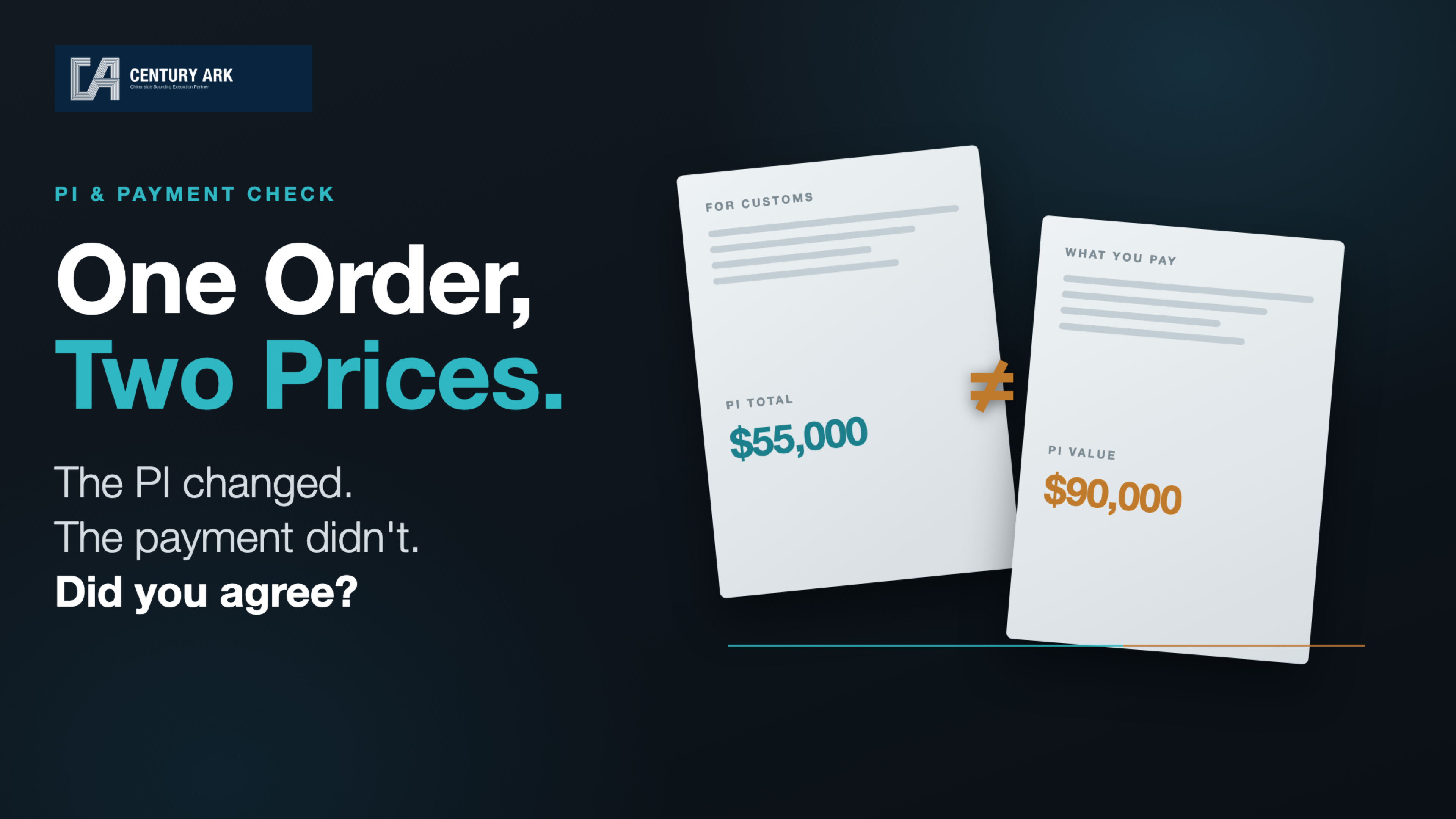
Consider a simplified component order. The PO, agreed payment and actual remittance are all USD 90,000. The buyer also asks for a USD 55,000 “customs PI.” If the declared value is later questioned, the issue is no longer whether the Chinese supplier received USD 90,000. It is why the same components carry two values that cannot be explained by a change in quantity, product, freight or commercial terms.
Under the WTO customs-valuation framework, the transaction value starts with the price actually paid or payable. An invoice can represent that value, but it is not automatically the customs value in every case; customs authorities may examine the accuracy of declarations and supporting documents. The exact import treatment is jurisdiction-specific, so a buyer must obtain advice from its own qualified broker or adviser rather than rely on the supplier’s assurance alone. WCO Customs Valuation FAQ
There is also a China-side reason a supplier may decline. Article 15 of China’s Regulations on the Implementation of Customs Administrative Penalties treats false declarations of import or export price as a sanctionable matter. The provision specifically addresses consequences where a false declaration affects foreign-exchange or export-tax-refund administration. A supplier’s refusal may therefore be risk control, not a lack of willingness to serve the buyer. Article 15, Chinese official legal database
2. A higher PI may be aimed at export-side benefits. It is not automatically “the supplier’s own issue.”
When a Chinese supplier asks for a higher-value PI while keeping the payment unchanged, the commercial motivation is often export-side: a hoped-for tax-refund benefit or another settlement advantage. That motivation can be stated plainly.
But increasing the number on a PI does not, by itself, create an export VAT refund. China’s export tax treatment depends on the export model, goods, purchase records and other supporting information. If a higher amount enters export declaration, tax-refund or related records while the contract and payment remain unchanged, the buyer is being asked to accept a document that does not match its actual cost.
Again, consider the same component order. The actual contract and payment are USD 90,000. The supplier asks for another document showing USD 120,000 for its export-side processing. Even if the buyer does not participate in any tax-refund application, it may still hold, accept or be asked to confirm a commercial document inconsistent with the amount it actually pays.
This is not a theoretical concern. In 2025, the Shanghai tax authority published an enforcement case involving enterprises that exported low-value silicone products at abnormally high declared prices to obtain export tax refunds. The case involved more than a high price alone; it also involved false export declaration and foreign-exchange settlement facts. It does not mean that every higher export price is improper. Product configuration, service scope, Incoterms and genuine price changes can all explain a difference. It does show why “this is only the supplier’s refund arrangement” is not a sufficient answer when the value cannot be supported by the real transaction. Shanghai tax authority case
3. The buyer’s asset is not a second PI. It is one evidence trail for the order.
The buyer may see an import-side tax benefit in a lower PI. The supplier may see an export-side benefit in a higher PI. Both parties may call the request a paperwork adjustment because the goods and cash payment have not changed.
That is precisely why the buyer should focus on the evidence trail. If the order is later reviewed in connection with a payment reconciliation, customs inquiry, warranty dispute or document audit, can the buyer show one coherent set of documents: the PO or contract, the agreed scope, the payment, and the records used for the relevant declaration?
If there is a real commercial change, document it as such. Update the PO or contract as appropriate, align the payment arrangement, and obtain advice on the required customs treatment. That is a normal commercial adjustment.
If the only explanation is “customs needs a lower number” or “our export side needs a higher number,” while the real goods, scope and payment do not change, the buyer should not treat it as a routine document request. It is time to pause, not to let a counterparty’s “it will not affect you” replace an independently supportable explanation.
Before agreeing to issue, accept or rely on another PI, a buyer should ask:
Check 1: Who will use this document, and for what process?
Is it an internal quotation, a contract amendment, support for an import declaration, support for an export declaration, or something else?
Check 2: What real commercial event explains the value change?
Is there a change in quantity, configuration, freight, insurance, service scope, discount or Incoterms? Or is the different number intended only to produce a different customs or tax result?
Check 3: Can the PO, payment and related documents explain each other?
If the answer depends on hiding the original document or treating the payment record as irrelevant, it is no longer ordinary document management.
Check 4: Who can independently confirm the relevant declaration treatment?
The importer should obtain advice based on its actual transaction and local rules. The Chinese exporter must separately confirm its own export, settlement and tax treatment. Neither party should treat the other’s informal assurance as a substitute for that review.
One cross-border order can involve revised quotations, supplementary documents and genuine commercial adjustments. It should not depend on two incompatible price stories.
The component order in this article is simplified and anonymised. This article is not tax, customs, foreign-exchange, legal or accounting advice. Customs valuation, import declaration and document requirements vary by jurisdiction and transaction structure; seek qualified advice for a specific arrangement.
Need a clearer evidence trail before accepting another PI?
Start with the actual order scope, payment record, and document purpose that need to be reconciled.
Request a review