
Decision lens
Before the deposit becomes a production commitment, establish the final technical baseline, actual route, and buyer approval point for changes that can affect the order.
The sample has passed testing. The price is acceptable. Your engineering team is satisfied, your customer may be waiting for delivery, and the project already has a date attached to it.
Now the supplier is asking for the deposit and wants to start production.
At that moment, many buyers understandably ask: “When can you ship?”
But before releasing the first production PO, a more important question may be:
What, exactly, will run this order?
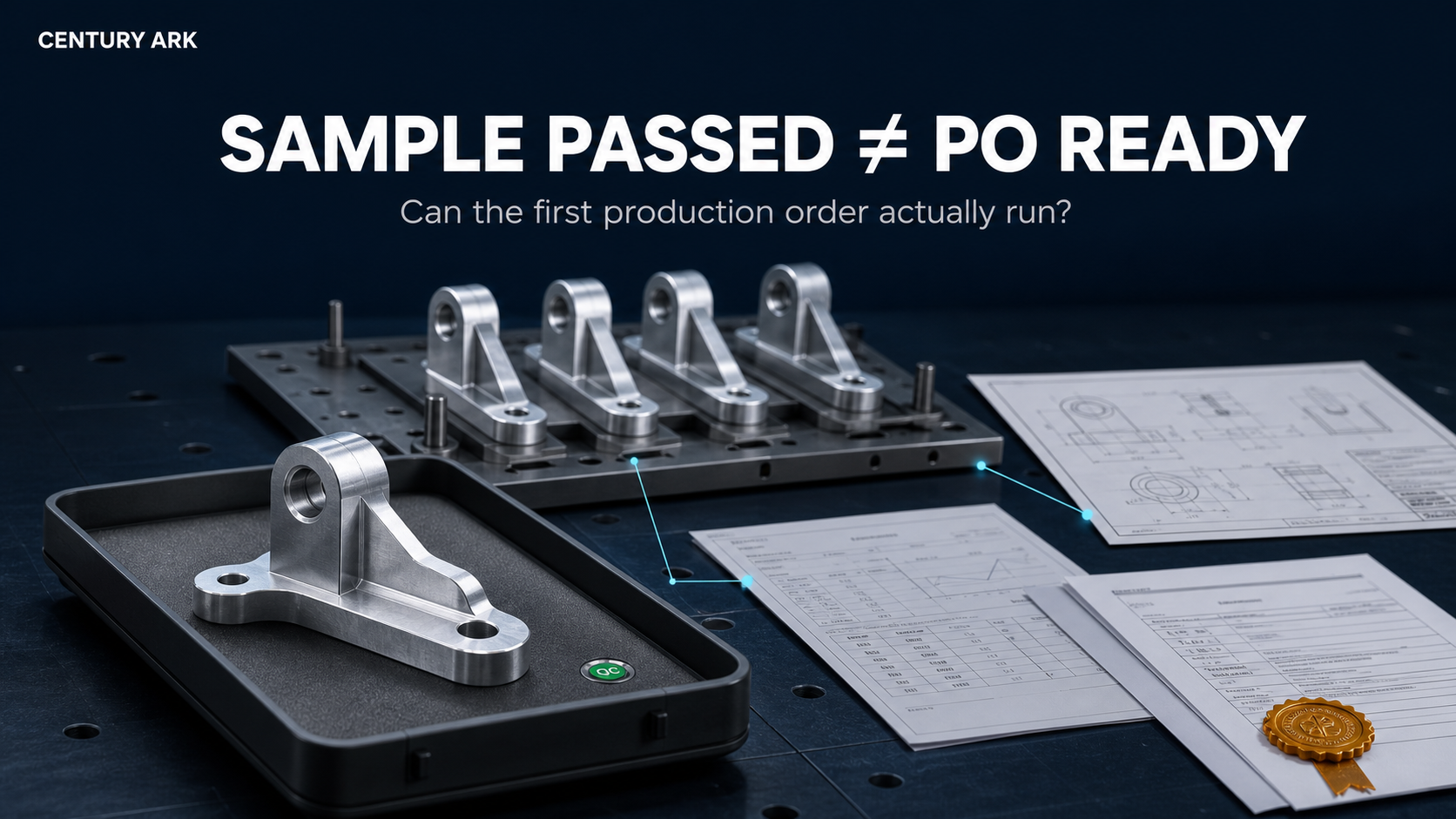
A sample proves that a part can be made. A production PO requires evidence that the order can be completed repeatedly, to the agreed requirements, under conditions that are controlled well enough for the buyer to make a commitment.
That difference is easy to underestimate because the sample is tangible: it can be inspected, tested and approved. A production commitment is less visible. It depends on conditions that may only become relevant after the buyer has paid a deposit, promised a delivery date or committed inventory and launch resources.
This is not a criticism of sample work, nor an assumption that a supplier is unreliable. A good sample can show that the supplier understands the part, has access to a viable process route and can communicate effectively during development. But the first production PO changes the nature of the decision. It turns one successful result into a commitment on quantity, lead time, quality, records and change control.
A simple order scenario
Consider an anonymised example. A buyer is sourcing a custom industrial component for a scheduled product programme. The supplier has produced acceptable samples after minor drawing clarification, the quotation works, and the supplier requests a deposit to secure a delivery slot.
The sample was made successfully with material available at the time, a suitable machine and the supplier’s normal technical attention. That is valuable evidence. But once the PO is released, several order-specific questions become real:
Will the final production run use the same approved technical baseline?
Will the specified material and any critical outside process be ready for the production window?
Which actual site, equipment, tooling and process route will carry the required quantity?
If a material, process or specification issue emerges, does the buyer have a clear point at which a decision or approval is required?
None of these questions means that the sample is invalid. They simply recognise that a trial part and a production order are not the same operating event.
The sample answers: “Can this part be made?”
The PO needs to answer: “Can this quantity be made, to this version, through this route, within this window?”
Point 1: The sample needs to become a controlled production baseline
At sample stage, some details may still be provisional. A drawing revision may be under discussion. A material grade may be clarified after testing. A surface-finish requirement, inspection method, packaging detail or accepted deviation may exist in an email thread rather than in the final technical package.
That can be entirely normal during product development. It becomes a problem only when the first production order begins without a shared view of which requirements now govern the work.
The buyer should be able to identify the final production baseline: the applicable drawing or CAD revision, BOM where relevant, material requirement, critical dimensions, finishing requirement, inspection criteria and any agreed deviations. The requirements that matter should not exist only in separate conversations or in the supplier’s interpretation of the approved sample.
An unclear baseline can turn a later quality discussion into a dispute about what was actually ordered. By then, the cost of rework, replacement, delay or acceptance decisions is far higher than it was before the PO was released.
The issue is not whether the sample was good. It is whether the production order is being built to the same controlled expectation.
Point 2: A PO needs an execution route, not a general capacity claim
“We have capacity” is a useful starting statement. It is not yet an execution plan for a specific PO.
For a customised, time-sensitive or quality-critical order, the part may pass through more than one production node: machining, forming, heat treatment, coating, assembly, testing, packaging or an outsourced special process. The practical question is whether the route for this particular order has been understood early enough.
Which actual production site will make the part? Which equipment, tooling, line or production window is expected to carry the required quantity? Has the material been identified against the PO requirement? Is the critical outsourced process available in the same timeframe? If the sample was made during a short trial run or a spare production slot, what will support the larger production quantity?
The buyer does not need to manage the factory’s entire schedule. But the relevant route for the PO should be clear enough to identify a material, process or capacity constraint before it turns into a late-delivery problem.
That is especially important for a first order. It is often the first time that material planning, production scheduling, subcontractor coordination, inspection discipline and delivery preparation must operate together for the buyer’s requirements.
Point 3: Changes need a buyer decision gate
Production does not always follow a perfectly straight line. A material substitute, process adjustment, outside-process change or specification interpretation may sometimes be proposed for practical reasons. In some cases, the change may be technically acceptable. In others, it may affect performance, appearance, cost, traceability, downstream approval or the buyer’s own customer commitment.
The important question is not whether every change is unacceptable. It is whether the parties have agreed which changes must be visible to the buyer and approved before they affect the order.
Without that decision gate, the buyer may only learn about a difference when goods are ready for inspection or shipment. At that point, the options are rarely attractive: accept the difference, request rework, wait for replacement material, delay the shipment, or revisit a commitment already made to an internal team or customer.
This is why change control is not merely a quality-system term. For the buyer, it is a commercial protection point. It preserves the ability to decide while there is still time to decide.
What needs to be clear before the deposit becomes a production commitment?
Not every order needs a lengthy factory audit. The level of checking should reflect the product, criticality, delivery window and maturity of the supplier relationship. But before a first production PO is released, a few order-specific questions should have clear answers:
Check 1: Which actual site and process route will run this PO?
Check 2: Which final technical documents and accepted deviations govern production?
Check 3: How are the specified material, critical outsourced processes and relevant production window expected to support the required quantity and delivery date?
Check 4: Which inspection records, quality points and changes require the buyer’s review or approval before shipment?
These questions do not create a guarantee of delivery. Their value is earlier visibility. They distinguish what is confirmed, what is planned and what remains open for a buyer decision before the deposit, delivery commitment and project timeline are fully locked in.
Where China-side execution support fits
For overseas buyers, the challenge is often not a lack of suppliers, samples or quotations. It is the distance between the commercial decision to place an order and the operational facts that will determine how the order is carried out in China.
China-side supply-chain execution is not about replacing the supplier, acting as a certification body or promising that no disruption will occur. Its practical role is to help make the relevant facts observable at the point where they can still inform a decision: the actual production site, the key process nodes, material and subcontractor arrangements, production milestones, inspection requirements and change conditions.
For a new, customised or delivery-critical PO, that can mean confirming the agreed scope, following key milestones, and returning a factual record of confirmed items, open points and decisions that still need the buyer’s direction.
The objective is not to create more paperwork. It is to reduce the gap between what the buyer assumes has been arranged and what the order-specific evidence shows has actually been arranged.
The decision behind the first PO
A good sample is an important reason to continue evaluating a supplier. It may be the right basis for moving forward.
But it does not replace the evidence needed to release the first production PO.
When the supplier is waiting for the deposit and the project timeline is ready to move, the decisive question is no longer only whether the part can be made.
It is whether you can clearly explain how this order will actually be run.
This article reflects a China-side supply-chain execution perspective. It is not a factory audit, quality certification, delivery guarantee or legal advice. Each order should be assessed according to its product, supplier, commercial terms and destination-market requirements.
Need a clearer first-production baseline before releasing a PO?
Start with the order route, agreed technical record, and decision points that need to be clear before production begins.
Request a review