
Decision lens
Before treating a rebate rate as a commercial benefit, establish the calculation base, export model, and evidence supporting the assumption.
A supplier says the export tax rebate has already been reflected in the price.
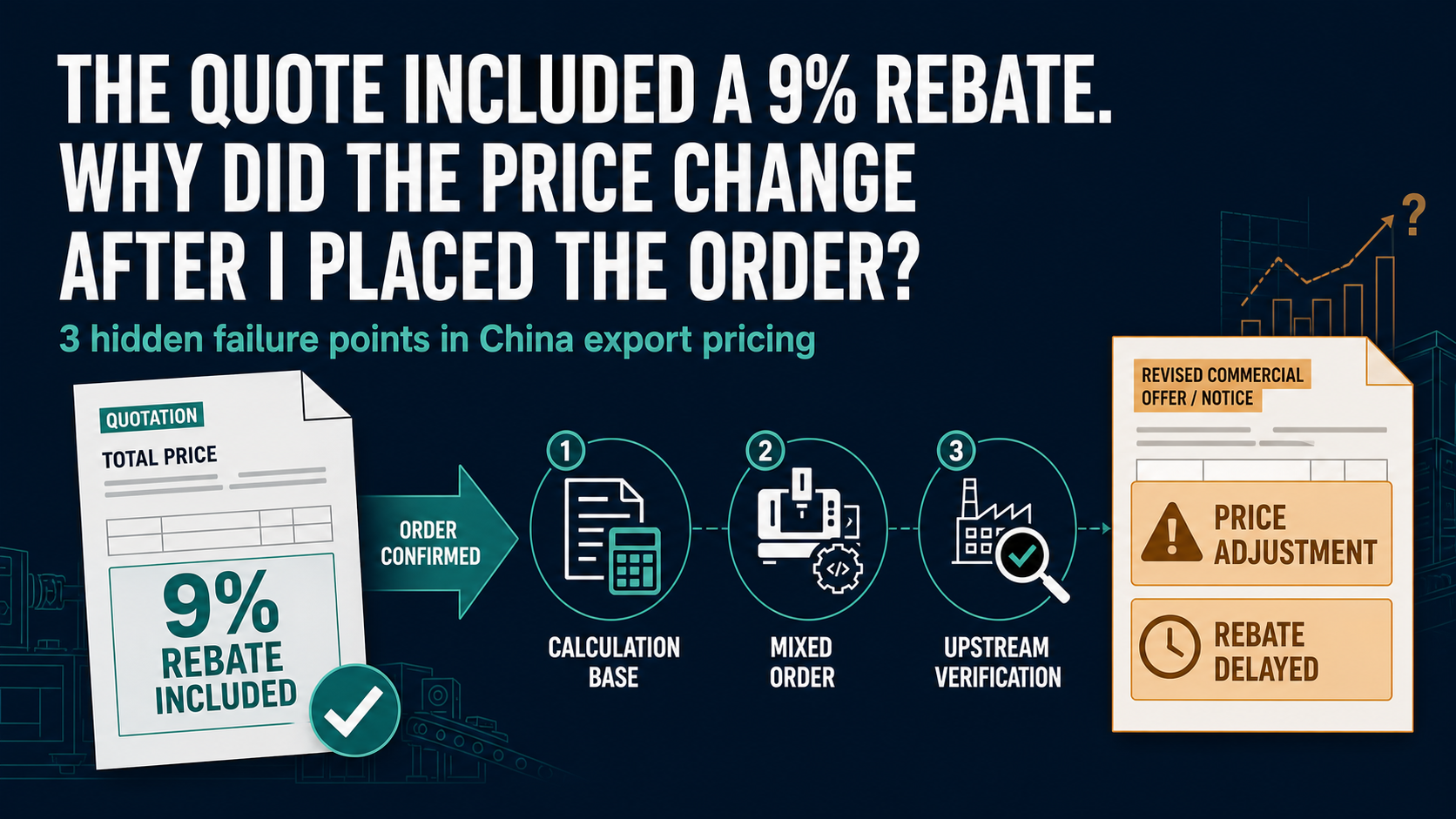
The order is confirmed. Production begins. Then something changes: the exporter says the rebate is lower than expected, asks for a price adjustment, delays returning an agreed benefit, or becomes cautious about the next shipment.
This is not always simply an excuse.
In many cases, the rebate assumption was unreliable from the beginning.
Overseas buyers often focus on one visible number: the published export rebate rate. But that rate does not tell them how much tax can actually be recovered, which parts of the order qualify under that rate, or whether the upstream supply chain can withstand a tax review.
Three less obvious issues explain many of the gaps between the original quotation and what happens after shipment.
1. The rebate rate may be applied to a different value from the one used in the buyer's calculation
A common assumption is that a 9% rebate gives the exporter 9% of the export selling price back, creating the same amount of room for a price reduction.
That is often the wrong calculation.
For a Chinese trading exporter, the refundable amount is generally linked to qualifying domestic purchase documents and the applicable rebate rate. The overseas buyer, however, normally sees the export selling price. These are not necessarily the same value.
Consider a simplified example.
A trading company purchases mechanical components from a factory for RMB 1,000,000 before VAT. The factory issues a special VAT invoice at 13%, showing RMB 130,000 of input VAT. The confirmed export rebate rate for the product is 9%.
Ignoring other adjustments, the calculated rebate would be approximately RMB 90,000, not RMB 130,000. The remaining RMB 40,000 is not automatically recovered simply because the goods have been exported.
Now assume the components are sold overseas for the equivalent of RMB 1,200,000. Applying 9% directly to that export selling price would produce RMB 108,000, which is also not the same as the simplified rebate calculation above.
This is where many commercial discussions go wrong: the buyer and exporter use the same percentage but apply it to different numbers.
The exporter may also be pricing in the non-refundable tax difference, financing time, exchange-rate exposure, customs costs and the risk of additional review. A manufacturer using China's exemption-credit-refund method will have yet another calculation structure.
The useful question is therefore not only, “What is the rebate rate?” It is, “What value is that rate being applied to, under which export model, and how was the expected benefit built into the quotation?”
2. One commercial order may contain several different tax treatments
Commercially, a buyer may be purchasing one production line. For customs and tax purposes, however, the same project may consist of several products and services with different classifications and calculation bases.
Imagine a USD 300,000 automated production line:
- USD 240,000 for the main equipment;
- USD 20,000 for spare parts and special tools;
- USD 10,000 for remote software and commissioning support; and
- USD 30,000 for international freight and insurance.
If the supplier says that “the entire order receives the equipment rebate rate,” the estimate needs closer examination.
The main machine, spare parts and tools may fall under different HS codes and rebate rates. Remote software or commissioning may be treated as services rather than exported goods. International freight and insurance cannot simply be included in the goods rebate base as though they were part of the FOB value.
The problem may remain invisible during negotiation because the quotation shows only one total price. It often appears later, when the commercial invoice, customs declaration and accounting records require the project to be separated into its actual components.
That can explain why an exporter initially offers a rebate-based discount but later seeks to revise the price: the commercial package was treated as one item, while the export filing could not support one uniform rebate assumption.
For turnkey equipment and goods-plus-services projects, buyers should ask for an early breakdown of the principal goods, spare parts, services and international logistics costs. The more complex the package, the less reliable a single rebate percentage becomes.
3. Complete export documents do not eliminate upstream supplier risk
An exporter may have a sales contract, customs declaration, shipping documents and foreign-exchange receipt that all appear complete. The rebate can still be delayed because the review may extend upstream.
Tax authorities may examine whether the goods were genuinely purchased, whether the supplier had the capacity to produce or supply them, whether the invoice and payment flows are credible, and whether the supplier has abnormal tax or operating records. In higher-risk cases, tax authorities in the exporter's location and the supplier's location may conduct a verification process.
Consider another simplified example.
An exporter that normally buys standard fasteners suddenly purchases a large quantity of high-strength special bolts from a newly established supplier. The export documents are consistent. However, the supplier's machinery, electricity consumption, raw-material purchases and workforce do not appear sufficient for the invoiced production volume.
The key question is no longer whether the exporter prepared the shipping documents correctly. It is whether the upstream goods and invoice represent a credible transaction.
If the supplier cannot provide convincing production, purchasing, inventory and delivery evidence, the exporter's rebate may be delayed or otherwise affected.
weak upstream evidence -> additional verification -> delayed rebate -> exporter cash-flow pressure -> price changes, delayed benefit sharing or reluctance to continue shipping
This is why checking only a supplier's business licence and ability to issue an invoice is insufficient. A low-priced supplier with weak operating substance may create costs that appear only after the goods have entered the export process.
The question buyers should ask
For an overseas buyer, a Chinese export tax rebate is not a discount that can be claimed directly from the tax authority. Any benefit reaches the buyer only through the exporter's pricing and contractual arrangement.
Instead of asking only:
“What is the rebate rate for this product?”
Ask:
“What calculation base, transaction structure and upstream evidence support this rebate assumption?”
The published percentage matters. But the reliability of the price depends on what sits behind it.
The examples above are simplified for discussion and do not represent the final tax calculation for any specific transaction. Actual treatment depends on the product, HS classification, export entity, transaction model, qualifying documents and review by the competent authorities. This article is not tax, customs, foreign-exchange or legal advice.
Have a sourcing question affected by export documents or supplier evidence?
Start with the specific decision and the evidence currently available. The next step can be scoped from there.
Request a review