
Decision lens
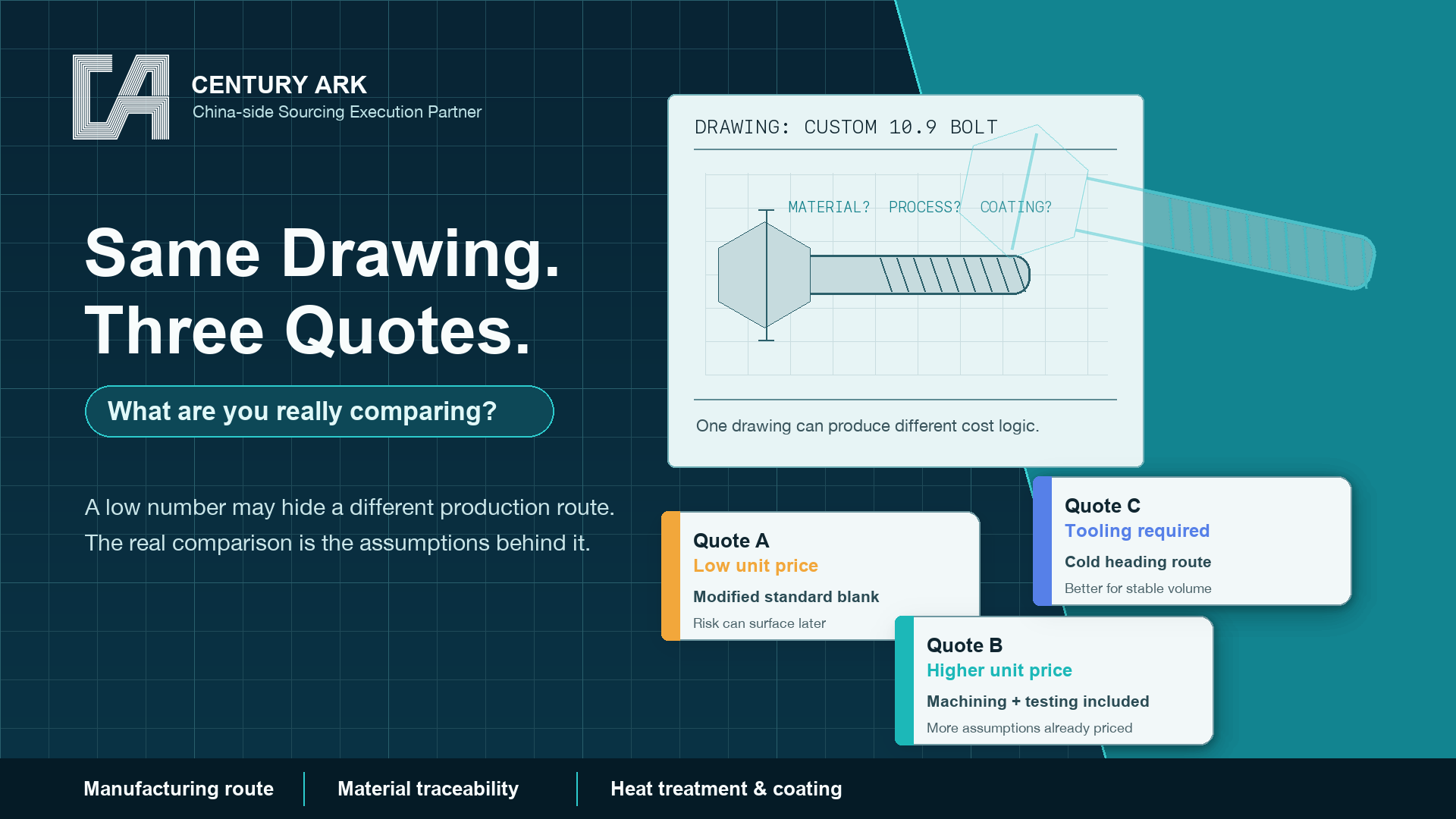
Before comparing a number, establish the manufacturing route, material plan, treatment scope, and volume logic each supplier has priced.
If you source custom bolts, pins, rivets, special nuts, or machined connectors from China, this situation may look familiar.
You send the same drawing to several suppliers. The quantity is the same. The material and finish are written on the drawing. The requested lead time is also similar.
But the quotations come back with a wide gap.
One supplier gives a very low unit price but explains little about the process. Another supplier is more expensive and asks questions about material grade, heat treatment, coating, salt spray testing, tolerances, and end use. A third supplier says the MOQ is too low and suggests changing the process.
From the buyer's side, this may look like price opacity. It may feel as if some suppliers are simply expensive, while others are more competitive.
Sometimes that is true. But in custom fasteners, a large price gap often means something more specific: the suppliers are not quoting the same manufacturing assumption.
This matters even more now. Metal-related trade costs are more visible, and the EU Carbon Border Adjustment Mechanism covers certain iron and steel fasteners under CN 7318.
But for a custom fastener, the hidden cost is often not in the policy itself. It is in the manufacturing route, material interpretation, heat treatment, coating, and quality responsibility behind the quotation.
1. The Same Drawing Does Not Mean the Same Manufacturing Route
A buyer sends a drawing. A supplier first asks a different question:
How should this part be made?
For the same custom fastener, there may be several possible routes: cold heading with thread rolling, CNC turning, hot forging followed by machining, modifying a standard blank, or opening a dedicated tool. These routes do not have the same cost structure.
Imagine a custom 10.9 grade bolt with a special head shape, a shoulder feature, and a non-standard length. The first order is only 3,000 pieces. One supplier quotes cold heading with tooling, another quotes turning or secondary machining, and a third assumes that a standard bolt can be modified. The prices are different because the execution plans are different.
Before judging which quote is “expensive” or “cheap,” the buyer should ask what process is being quoted, whether tooling is included, whether samples and mass production will use the same route, and whether inspection documents are included.
If these assumptions are not clear, the lowest price may simply mean the supplier has assumed a simpler process, a higher production risk, or a route that may not be suitable for long-term production.
2. A Material Grade on the Drawing Does Not Automatically Control Material Risk
Material is another area where custom fastener quotes can diverge.
An overseas buyer may write ASTM, SAE, DIN, ISO, or AISI references on the drawing: 304, 316, 4140, 1045, carbon steel, alloy steel, stainless steel, 10.9, or 12.9.
But on the China side, the supplier still needs to translate that requirement into an actual purchasing and verification plan. The issue is usually not whether China has an equivalent material. The issue is whether equivalence, traceability, and testing responsibility have been defined.
If the drawing says 316 stainless steel, is the supplier quoting 316, 316L, or a cheaper stainless alternative? If the drawing says 10.9 grade, has the supplier considered suitable alloy steel, heat treatment, and mechanical testing? If a material certificate is required, can it be traced to the heat number, or is it only a generic certificate?
Consider a custom connector for outdoor equipment. The drawing specifies 316 stainless steel because the end-use environment involves moisture and salt exposure. A low-cost quotation may be based on 304 stainless steel or a vague “equivalent stainless steel” assumption. The part may look acceptable at delivery, but corrosion problems may appear months later.
High-strength fasteners have a different version of the same problem. A buyer sees 10.9 or 12.9 as a grade. The supplier sees material selection, heat treatment, hardness, tensile strength, and failure responsibility. If a supplier only says “we can make 10.9” without explaining material, heat treatment, and testing, the quote is incomplete.
For custom fasteners, “produce according to drawing” is not enough. Buyers should confirm the material grade, certificate traceability, sample-to-mass-production consistency, and whether any material substitution is allowed.
These questions may slow down the quotation stage, but they prevent a price discussion from turning into a quality dispute later.
3. Heat Treatment and Surface Treatment Can Be the Real Price Difference
Many fastener buyers focus on dimensions, material, and unit price. Heat treatment and surface treatment often receive less attention.
But for industrial fasteners, these processes may determine whether the part performs safely.
“Zinc plated” may mean basic electro-zinc plating, hot-dip galvanizing, or zinc-nickel coating. A salt spray requirement of 480 or 720 hours needs a test method and acceptance criteria. High-strength fasteners may also require hydrogen embrittlement risk control after electroplating or acid cleaning.
A buyer needs a custom 10.9 grade bolt with zinc plating and a higher salt spray requirement. One supplier quotes only basic electroplating and standard packing. Another supplier includes heat treatment control, hydrogen embrittlement risk management, salt spray testing, thread re-checking, and batch inspection.
If the buyer only compares unit price, the second supplier looks expensive.
But if the part is used in a load-bearing, vibrating, or outdoor application, ignoring heat treatment and coating risk may lead to more than cosmetic defects. It can lead to broken bolts, failed assembly, field claims, or a dispute over responsibility.
This is one of the most important points in custom fastener sourcing: the buyer is not only buying a metal part. The buyer is buying a controlled manufacturing process.
Before accepting a quotation, buyers should ask whether heat treatment is in-house or outsourced, whether testing is included, whether the coating supplier is stable, whether high-strength parts have hydrogen embrittlement risk controls, and whether coating thickness affects thread fit.
These sound technical, but for procurement teams they become commercial questions: Will delivery be delayed? Will the price change later? Can quality responsibility be traced?
The Better Question
For custom fasteners, the most important question is not:
How much is this bolt?
The better question is:
What manufacturing assumptions are included in this price?
A meaningful quotation comparison should cover four areas: manufacturing route, material plan, heat treatment and coating, and volume logic from prototype to mass production.
In many cases, one supplier is not simply “cheap” and another supplier is not simply “expensive.” They may be placing the risk in different parts of the order. A low price may leave process risk for later production. A higher price may already include tooling stability, inspection, traceability, coating control, and failure responsibility.
Professional sourcing is not about choosing the lowest number. It is about understanding whether the prices are based on the same manufacturing plan.
In a market where tariffs, carbon cost, steel prices, and delivery pressure are all less predictable, this becomes even more important. If the China-side quotation assumptions are wrong at the beginning, the buyer may not only lose a few cents per piece. The real cost may be delay, rework, rejected goods, claims, or a complete supplier change.
This article is a practical sourcing perspective, not legal, tax, customs, or technical certification advice. Each product should be reviewed according to its drawing, end use, destination market, and applicable standards.
Need to compare quotations before you commit further?
Start with the drawing, decision, and the assumptions that still need to be made clear.
Request a review