
Decision lens
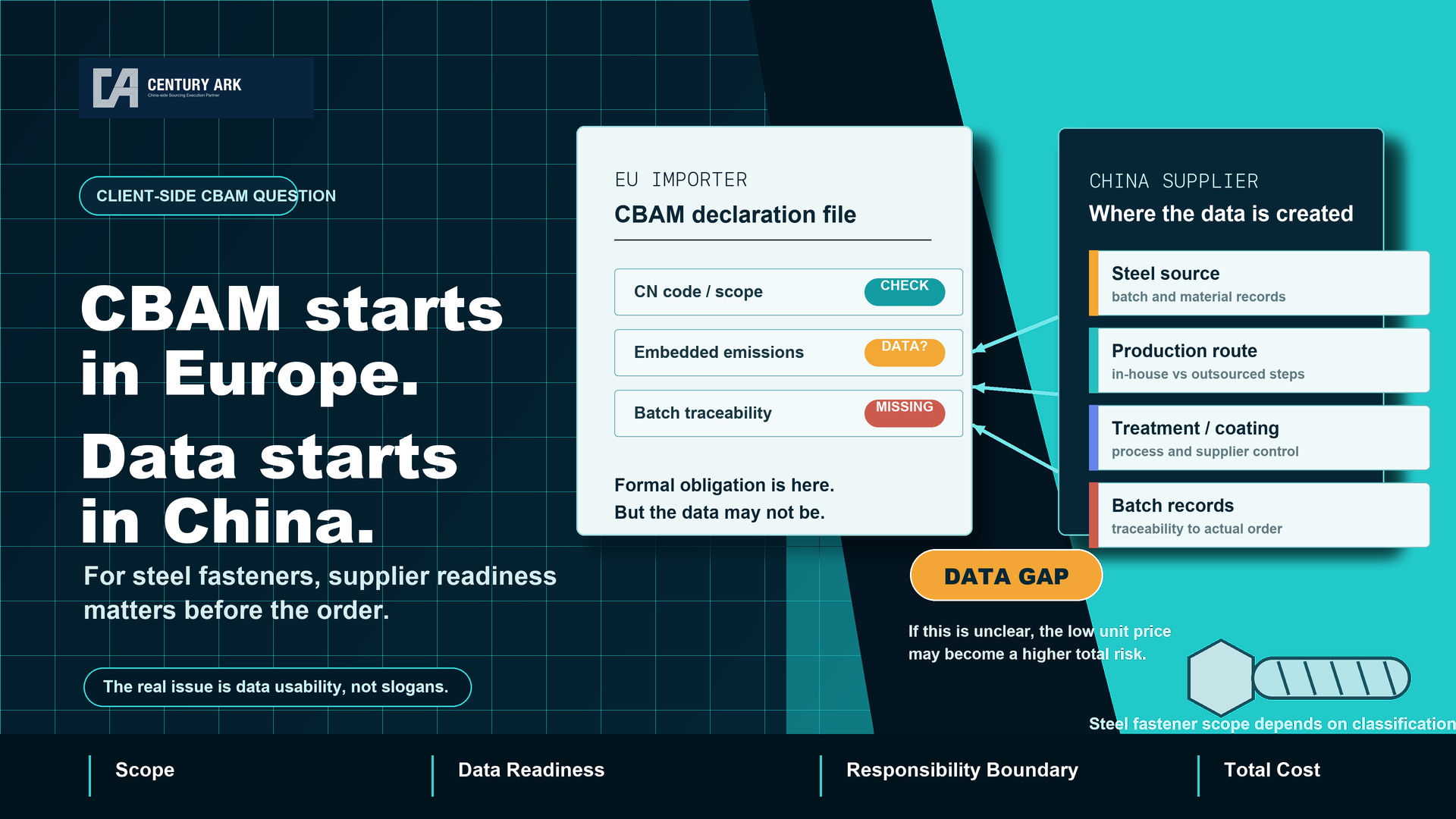
Before ordering, establish whether the supplier can connect China-side product, process, and batch information to the EU import process that may require it.
If you import steel bolts, nuts, washers, rivets, custom pins, or machined fastening parts from China into the EU, CBAM is no longer something to consider only after the shipment arrives.
But there is one important misunderstanding.
CBAM is not something a Chinese supplier can “solve” on its own. The declaration, authorisation, and certificate obligations sit mainly on the EU import side, with the EU importer or its indirect customs representative. A Chinese supplier is usually not the CBAM declarant.
The real issue is more practical. To handle CBAM, the EU importer may need information from the China-side supply chain: product classification, material, production route, steel source, heat treatment, surface treatment, outsourced processes, batch traceability, and emission-related data.
So the buyer's question should not be:
“Can this Chinese supplier solve CBAM for me?”
The better question is:
“Can this Chinese supplier provide enough reliable data for my EU import process to deal with CBAM?”
That difference matters. The first question often creates vague promises. The second can be checked before the order is placed.
1. A Small Part Is Not Automatically a Low-Risk Item
Many buyers first associate CBAM with bulk commodities: steel coils, aluminium ingots, cement, fertilisers, or other obvious carbon-intensive products. Compared with those items, a bolt or washer can look too small to matter.
But CBAM scope is not decided by the physical size of a part. It depends on whether the imported product falls within the covered goods, including the relevant CN code, material, and EU import structure. The EU CBAM product scope includes certain iron and steel products, and CN 7318 covers screws, bolts, nuts, rivets, washers, and similar articles of iron or steel.
So some steel fasteners cannot be dismissed simply because they are “only components.”
Consider a simplified example.
An EU equipment manufacturer buys custom 10.9 grade bolts from China for construction machinery assembly. The supplier quotes the product as “carbon steel bolt, zinc plated.” Internally, the buyer treats it as a normal mechanical component. But if the EU import classification places the product within the relevant iron and steel scope, the importer may need to manage it under CBAM.
If this is not discussed during quotation, the problem appears later. Near customs clearance, internal compliance review, or annual CBAM preparation, the importer asks the supplier for additional information. The supplier may not have prepared anything beyond the usual invoice, packing list, and material description.
The issue is not always refusal. More often, both sides failed to treat possible CBAM relevance as a quotation assumption.
Before placing the order, buyers should ask:
- What HS or CN classification is expected for EU import?
- Is the product made of iron or steel?
- Could the importer-side volume, structure, or customs arrangement bring the shipment into CBAM management?
- Does the supplier understand that CBAM-related information may be requested later?
These questions do not replace the EU importer's formal classification review. But they help identify whether the supplier understands the data expectation behind the order.
2. Data Capability Depends on Control of the Production Chain
Under CBAM, buyers may ask Chinese suppliers for “carbon data” or “emissions data.” In practice, the difficult part is often not whether the supplier is willing to fill in a form. The difficult part is whether the supplier knows where the underlying data comes from.
The production chain for a steel fastener can be more fragmented than it looks.
A simple bolt may involve steel purchasing, cold heading or machining, thread rolling, heat treatment, surface treatment, sorting, and packing. Heat treatment may be outsourced. Electroplating, zinc-nickel coating, or other surface treatment may be outsourced. Steel sources may change from batch to batch.
If the supplier is a trader, or if it controls only one process in the chain, its ability to support CBAM-related information may be limited.
This is why “we can provide CBAM documents” has limited value by itself. The buyer needs to know whether the supplier can connect those documents to the actual order, production route, and batch.
Consider another simplified example.
A buyer sources custom steel connectors from China. Supplier A is quick to quote and has an attractive price. But its execution model is fragmented: steel is purchased from the market, machining is handled by one subcontractor, heat treatment by another, and coating by a third. When the buyer later asks for production-route information and emission-related data, the supplier can only provide a general description. It cannot connect the data to the actual batch or outsourced processes.
From the buyer's side, this is not just a paperwork issue. It can affect three commercial items.
First, lead time may be extended because the supplier has to go back to upstream vendors and subcontractors for information that was never prepared at the start.
Second, the price may change because the original quote did not include data preparation, third-party calculation, verification support, or a more stable supply chain.
Third, responsibility becomes unclear. A generic spreadsheet may not be enough if the EU side later faces an internal audit, customer review, or CBAM data check.
Before ordering, buyers should ask:
- Are you the actual manufacturer, a trading company, or only responsible for part of the process?
- Can the steel source be traced by batch?
- Are heat treatment and surface treatment done in-house or outsourced?
- If processes are outsourced, can those subcontractors provide the required information?
- Is the data based on actual production records, estimates, default values, or templates?
- If third-party calculation or verification support is needed, how will time and cost be handled?
These questions sound more technical than ordinary purchasing questions. Commercially, they are still sourcing execution questions. A supplier that cannot explain its production route, subcontracting structure, and batch traceability will struggle to support reliable CBAM data.
3. The CBAM Cost Happens in Europe, But It Changes Supplier Selection in China
Many Chinese suppliers see CBAM as an EU importer issue. In terms of formal responsibility, that view is partly correct. Commercially, it is incomplete.
Once the buyer has to manage CBAM, the cost and uncertainty can flow back into China-side sourcing decisions.
If a supplier cannot provide reliable data, the EU importer may have to use a more conservative approach, rely on default values where applicable, spend additional time on internal compliance, or ask for external support. Even if the formal financial obligation remains in Europe, the buyer will compare suppliers based on total cost and total risk.
This means the lowest unit price may not be the lowest sourcing cost.
Consider a simplified RFQ for steel fasteners.
Supplier A offers a lower FOB price. It can provide normal export documents and a basic material description, but has no clear record of steel source, heat treatment subcontracting, surface treatment process, or batch-level production data.
Supplier B is more expensive. But it can explain the manufacturing route, identify which processes are in-house or outsourced, keep batch records, and cooperate with CBAM-related data requests within a defined time and cost framework.
If the buyer compares only the unit price, Supplier A looks more competitive. But if the buyer includes CBAM data work, default-value risk, internal compliance time, delayed information requests, and future supplier stability, Supplier B may be the more controllable option.
This is the most realistic commercial impact of CBAM on China-side fastener sourcing. It will not make every ordinary supplier build a complete carbon-management system overnight. That is not realistic for many small and mid-sized fastener manufacturers.
But it will make European buyers pay closer attention to data transparency, production control, and process stability.
For Chinese suppliers, the practical preparation is not to say “we are CBAM compliant.” A better preparation is to build a few basic capabilities:
- Confirm product classification, material, and production route;
- Explain which processes are in-house and which are outsourced;
- Keep necessary order-level or batch-level records;
- Distinguish actual data, estimated data, and default-value assumptions;
- State clearly whether CBAM-related information support is included in the price, and what extra time or cost may apply.
The More Realistic Question
CBAM does not make sourcing steel fasteners from China impossible. But it does change how buyers should evaluate suppliers.
In the past, buyers may have focused mainly on unit price, lead time, quality standard, and payment terms. For steel fasteners entering the EU market, one more dimension needs to be added: whether the supplier has enough data cooperation capability.
This does not mean every supplier must immediately have a mature carbon-accounting system. For many fastener suppliers, that would be unrealistic.
The more workable approach is to define responsibility before quotation and order confirmation:
- Which products may be relevant to CBAM?
- Who is responsible for the EU import declaration and CBAM process?
- What basic information must the Chinese supplier provide?
- Does the information need to be traceable to batch and process?
- If third-party calculation, verification, or extra documents are needed, who pays and how much time is required?
- If the supplier cannot provide actual data, what alternative approach will the importer accept?
For buyers, the riskiest supplier under CBAM is not necessarily the supplier without a perfect solution. The bigger risk may be the supplier that says “no problem” before understanding the requirement.
A more reliable supplier may actually ask more questions at the quotation stage: destination market, importer role, expected classification, actual-data requirement, heat treatment and coating scope, data format, and whether third-party support is needed.
Those questions may slow the quotation process. But they also show that the supplier understands where the risk sits.
For European buyers, the real sourcing question is not who can make CBAM sound simple.
It is who can explain the product, process, data, and responsibility boundaries clearly enough for the EU import process to work.
That is the practical risk-management point when sourcing Chinese steel fasteners under CBAM.
This article is a sourcing and supplier-readiness perspective. It is not legal, tax, customs, or carbon-accounting advice. Whether a specific product falls under CBAM, how it should be declared, whether actual or default values apply, and what certificate or verification obligations arise should be confirmed by the EU importer based on product classification, import structure, and the requirements of the relevant competent authority.
Need a clearer sourcing boundary before you order?
Start with the product, supplier structure, and the information route that needs to be made clear.
Request a review