
Decision lens
Before advancing a supplier, distinguish what registration records establish from the order-specific operating evidence still needed to judge the next step.
The registration fields behind it answer fewer questions than they appear to. A recent review shows what they can — and cannot — tell you before you order.
A recent case
A buyer from a US construction company recently approached Century Ark.
It was his first time selecting Chinese suppliers through Alibaba. He had shortlisted three companies but was unsure whether to proceed. Before placing an order, he wanted us to conduct a preliminary review.
Initially, he provided only the suppliers’ Chinese company names.
We checked registration records and publicly disclosed risk information in China’s National Enterprise Credit Information Publicity System, searched China Customs’ enterprise credit information platform, and cross-checked information using third-party company information tools.
The records showed that all three companies were legally registered and remained in existence at the time of review.
Within the sources and scope searched, we found no administrative penalty records or entries on the business abnormality or serious violation and dishonesty lists.
However, reviewing their registered business scopes, incorporation dates, personnel information, shareholders, and ownership relationships together left us with reservations about their operating foundations and ability to support future orders. The available information also did not establish their actual production arrangements or export routes.
We issued a preliminary report and recommended rebuilding the shortlist around suppliers with clearer evidence of their business operations.
That was a sourcing recommendation based on the information available. It did not establish that the three companies could not fulfill an order. We lacked sufficient grounds to recommend prioritizing them for further work.
What the case illustrates
Our review began with company names. Even if the buyer had obtained business licenses, the next question would have remained: what do these records actually tell us?
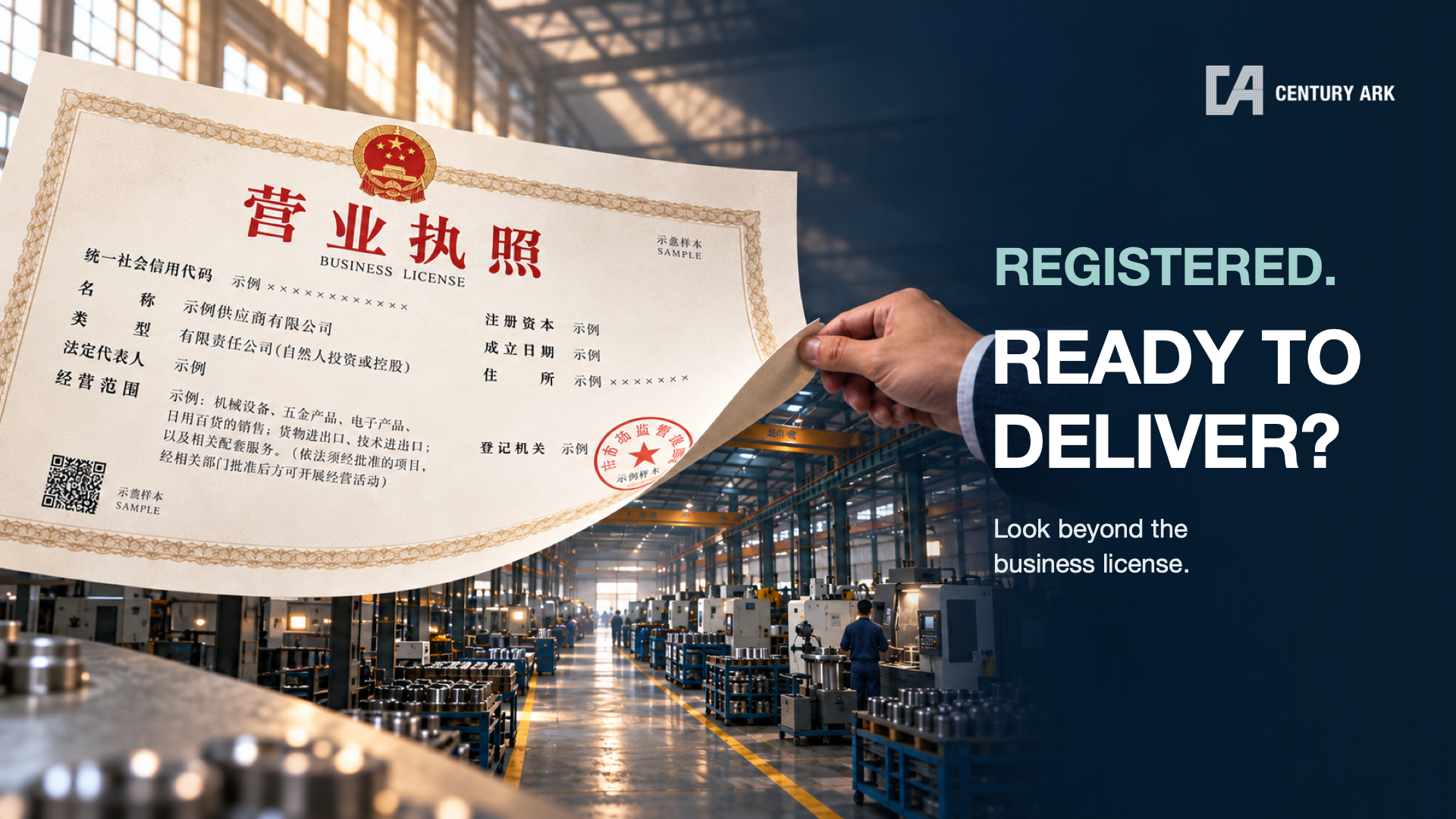
A business license contains registration fields that need interpretation. It provides information about a registered entity, but cannot, by itself, establish its ability to fulfill an order.
For a buyer, the task is to understand what each field supports—and what further evidence is needed.
Point 1: Business scope and the supplier’s actual role
Buyers may read “business scope” as a description of what a company actually does. More precisely, it records the company’s registered business activities, including general activities and those subject to licensing. Where a license is required, the relevant permissions need separate verification. Business Entity Registration Regulation, Article 14
If the scope mainly lists sales, agency services, or leasing, do not treat the entity as a verified manufacturer. Establish who actually produces the goods and how that producer relates to the company you would contract with.
Conversely, a manufacturing entry still requires evidence of the actual site, equipment, and personnel. The entry alone does not establish factory ownership.
For a trading company, quality and delivery also depend on its ability to organize and manage upstream producers. Understand who handles technical approvals, production coordination, and quality problems.
Check export arrangements separately. If the supplier says its own company will be the exporting entity, verify the corresponding customs filing as an import/export goods consignee or consignor. If an affiliate or agent will export, identify that entity and the responsibilities involved. A customs filing alone does not demonstrate export experience or the ability to execute this order. China Customs filing guidance
Check 1: Who manufactures, who contracts, who exports, and how are those entities connected?
Point 2: Registered capital and available funds
For a Chinese limited liability company, registered capital is the total capital subscribed by its shareholders. Subscription records their commitment to contribute; it does not establish that the full amount has been paid in.
Paid-in capital records contributions actually made. Those contributions can include cash, physical assets, intellectual property, and other eligible assets. Even cash contributions may since have been used in the business. Paid-in capital therefore cannot be treated as today’s bank balance, net assets, or ability to pay a claim. Company Law, Articles 47–48
Look beyond the license to the disclosed contribution information. Chinese limited liability companies must disclose subscribed and paid-in amounts, contribution methods, and dates. These requirements differ from certain annual-report fields, including some financial information, that companies may choose not to make public. Company Registration Implementation Measures, Article 11, Enterprise Information Disclosure Regulation, Article 9
A large registered-capital figure does not establish that the supplier can fund rework, refunds, or warranty obligations. A small figure does not establish that it lacks equipment, resources, or supply capability. Assess the evidence against the business and the proposed order.
Check 2: What do the contribution records show, and what operating evidence supports the supplier’s delivery and quality commitments?
Point 3: The registered entity and the actual operation
The registered address is a useful starting point, but should not automatically be treated as the production, storage, or dispatch location. Confirm where the goods will actually be made and shipped from.
The license does not list the actual workforce, equipment in use, or outsourced processes. Personnel information found elsewhere also needs a reporting date and a clear definition. Missing public information cannot simply be treated as evidence that a resource does not exist.
Incorporation dates, personnel records, and ownership relationships help identify further questions. They need to be reconciled with the supplier’s account of its business. For example, does its claimed experience belong to the current company, its team, or an associated manufacturer?
Without those connections, a buyer may verify a registered entity while still not knowing who will execute the order. That gap becomes practical when drawings need approval, production must be scheduled, or a quality problem requires action.
Check 3: Which operating location, producer, and team will support this order, and how?
Read the findings in context
A sales entity may rely on manufacturing resources held by a parent, subsidiary, or partner factory. The relationship alone does not establish that those resources are committed to the order, or that an affiliate will assume the contracting company’s responsibilities. Confirm the actual support and responsibility arrangements.
Likewise, no matching result on a customs platform calls for checking the name, Unified Social Credit Code, and search details. Another entity may handle exports; establish the route.
Keep information gaps, identified problems, and verified capabilities distinct.
Use the findings to decide what comes next
Start with the purchase requirements: product, order value, quality expectations, delivery needs, and the responsibilities the supplier must accept.
The same trading company may require different checks for a small standard-component purchase and a large custom-equipment order. Factory ownership should also be assessed against what the purchase requires.
If preliminary screening shows that a candidate fails a basic purchasing requirement, with no reasonable way to address it, further investigation may not justify the cost. Where a limited amount of additional evidence could resolve a gap, assess that before deciding whether to proceed.
In this case, we recommended a new shortlist. Having selected three candidates did not oblige the buyer to choose one of them.
The value of preliminary verification is a clearer decision before ordering: which candidates to advance, where to request more information, and where to stop prioritizing further work.
Scope and limitations
This article provides a simplified explanation of Chinese company registration and public-information checks. It is not legal, compliance, or tax advice. Business licenses and public records alone cannot establish production capability, financial condition, or ability to fulfill an order; those assessments require transaction-specific evidence.
Supplier identities have been anonymized. The case reflects a preliminary judgment based on limited information at a particular time. It should not be applied directly to other companies or transactions and provides no assurance of the suppliers’ current condition or any transaction outcome.
Need a clearer supplier-evidence boundary before ordering?
Start with the registered entity, actual operating route, and open questions that need to be separated before a supplier is advanced.
Request a review